

“I will start investing once my salary goes up.” “After the wedding.” “When the market settles down.” Every one of these sounds sensible. Each also hides a cost that is almost invisible on the day you decide to wait — and very visible twenty years later.
The cost is not the instalments you skipped
Suppose you plan to invest ₹10,000 a month for 25 years. If you wait five years, it looks as if you have only missed 60 instalments, or ₹6 lakh. The real loss is much bigger, because the instalments you skip are the ones that would have compounded for the longest.
| Start delayed by | Corpus at the same end date* | Smaller by |
|---|---|---|
| No delay (25 years) | ₹1.70 crore | — |
| 1 year | ₹1.51 crore | 11% (₹19.4 lakh) |
| 3 years | ₹1.18 crore | 31% (₹52.1 lakh) |
| 5 years | ₹92.0 lakh | 46% (₹78.2 lakh) |
| 10 years | ₹47.6 lakh | 72% (₹1.23 crore) |
*₹10,000 a month at an assumed 12% a year, all ending on the same date.
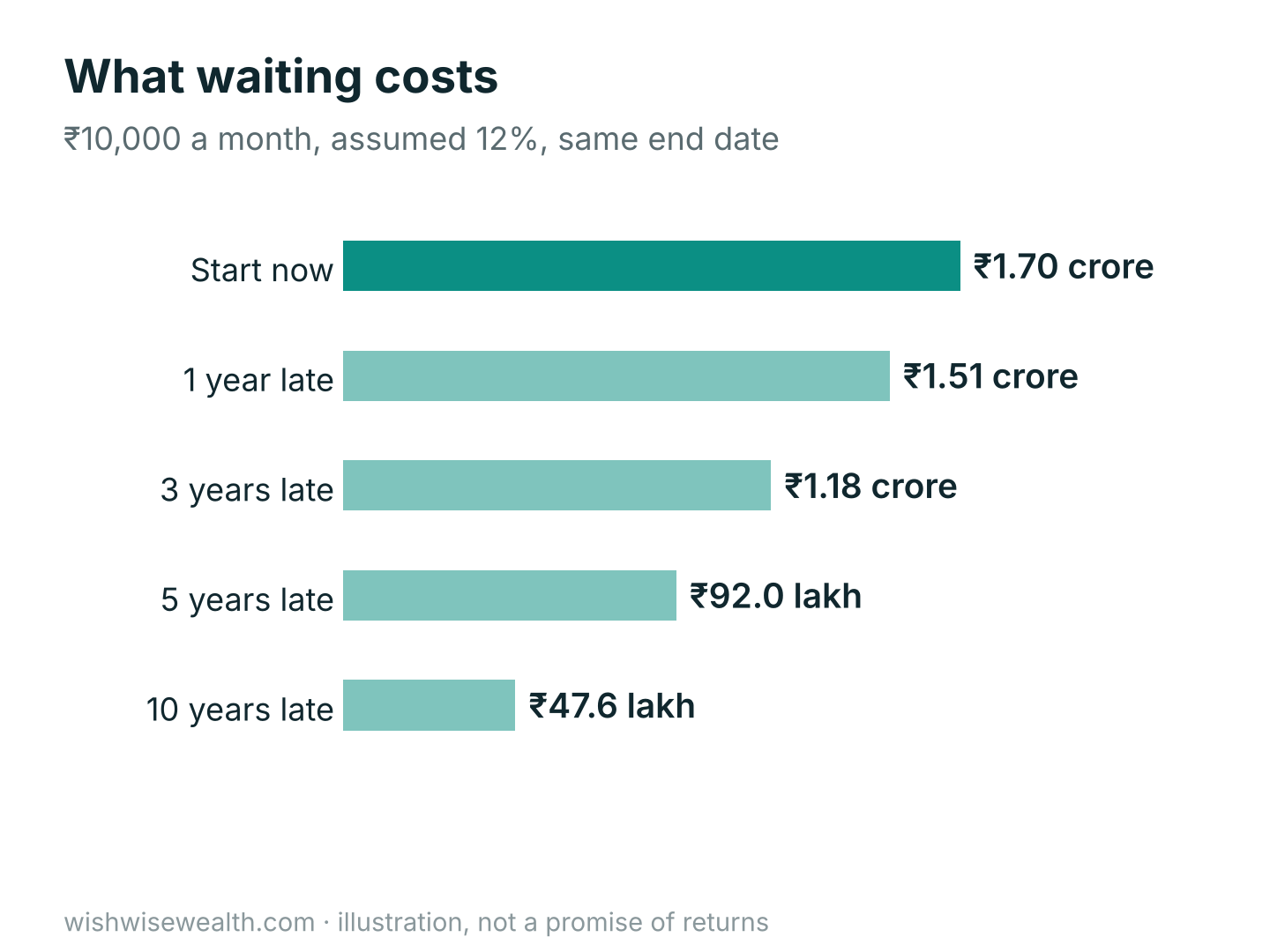
Five years of waiting cost ₹6 lakh of skipped instalments — and about ₹78 lakh of final corpus. The missing money is not the instalments; it is twenty years of growth on them.
Three friends and a retirement
Look at it through three friends who each invest ₹10,000 a month until 60, at an assumed 12% a year:
- Starting at 25: invests ₹42 lakh and ends with about ₹5.5 crore.
- Starting at 30: invests ₹36 lakh and ends with about ₹3.1 crore.
- Starting at 35: invests ₹30 lakh and ends with about ₹1.7 crore.
The friend who started at 25 invested only ₹6 lakh more than the friend who started at 30, but ends with about ₹2.4 crore more. These are future rupees, of course; at 6% inflation, ₹5.5 crore in 35 years buys roughly what ₹72 lakh buys today. The comparison between the friends still holds, because all three face the same inflation.
What catching up costs
If the friend who starts at 30 wants the same ₹5.5 crore at 60 as the friend who started at 25, she needs a SIP of about ₹17,900 a month — nearly double. Start at 35 and the catch-up SIP is about ₹32,400; at 40 it is about ₹59,900. Every five years of delay roughly doubles the monthly effort needed to reach the same goal. That is compounding working against you.
Why we wait anyway
- “The amount I can spare is too small to matter.” It matters more than it looks. Over 25 years, ₹2,000 a month started now ends up worth almost as much as ₹4,000 a month started five years later — five lost years cost you nearly double the effort.
- “The market is too high.” Markets have been called “too high” at almost every point in the last thirty years. A SIP spreads your buying across highs and lows, so you do not need to pick the moment.
- “I will invest my bonus in one go later.” You can still do that. It is not a reason to delay the monthly habit.
- “I do not understand it yet.” That is a fair reason — and the cure is a short conversation, not a five-year wait.
The way out: start small, step up
The answer to “I cannot afford ₹10,000” is not to wait until you can. It is to start with what you can afford today — even ₹1,000 or ₹2,000 — and raise it every year. A ₹3,000 SIP that steps up by 15% a year is above ₹10,000 a month by its tenth year, and the habit is in place from day one. Our article on step-up SIPs explains the maths in detail.
Before you start
- Keep three to six months of expenses in an emergency fund, so you never have to break the SIP.
- Take term life cover if anyone depends on your income, and health cover for the family.
- Pick a SIP date a few days after your salary arrives.
- Choose a fund that matches how long the money will stay invested.
Frequently asked questions
Is it ever right to wait?
Yes — if you have expensive debt such as credit-card dues or a personal loan at 14% or more, clear that first. Paying off 36% credit-card interest is a guaranteed return no fund can match.
I am 45. Is it pointless now?
Not at all. Fifteen years is still a long horizon for equity. The sums are smaller, so focus on a realistic goal, a higher savings rate and a sensible mix of equity and debt as you approach retirement.
See your own cost of waiting with our SIP calculator, or message us and we will help you start this month.
Figures above are illustrations based on assumed rates of return and are not a promise or guarantee of future returns. Mutual fund investments are subject to market risks, read all scheme related documents carefully. WishWiseWealth is an AMFI-registered Mutual Fund Distributor (ARN-188221).