

Most people start a SIP at an amount that feels comfortable in the year they start — and then leave it there for a decade. Their salary grows, their expenses grow, but the SIP stays frozen at ₹5,000 or ₹10,000. A step-up SIP fixes this with one simple rule: every year, the SIP goes up by a fixed percentage.
The same start, two very different results
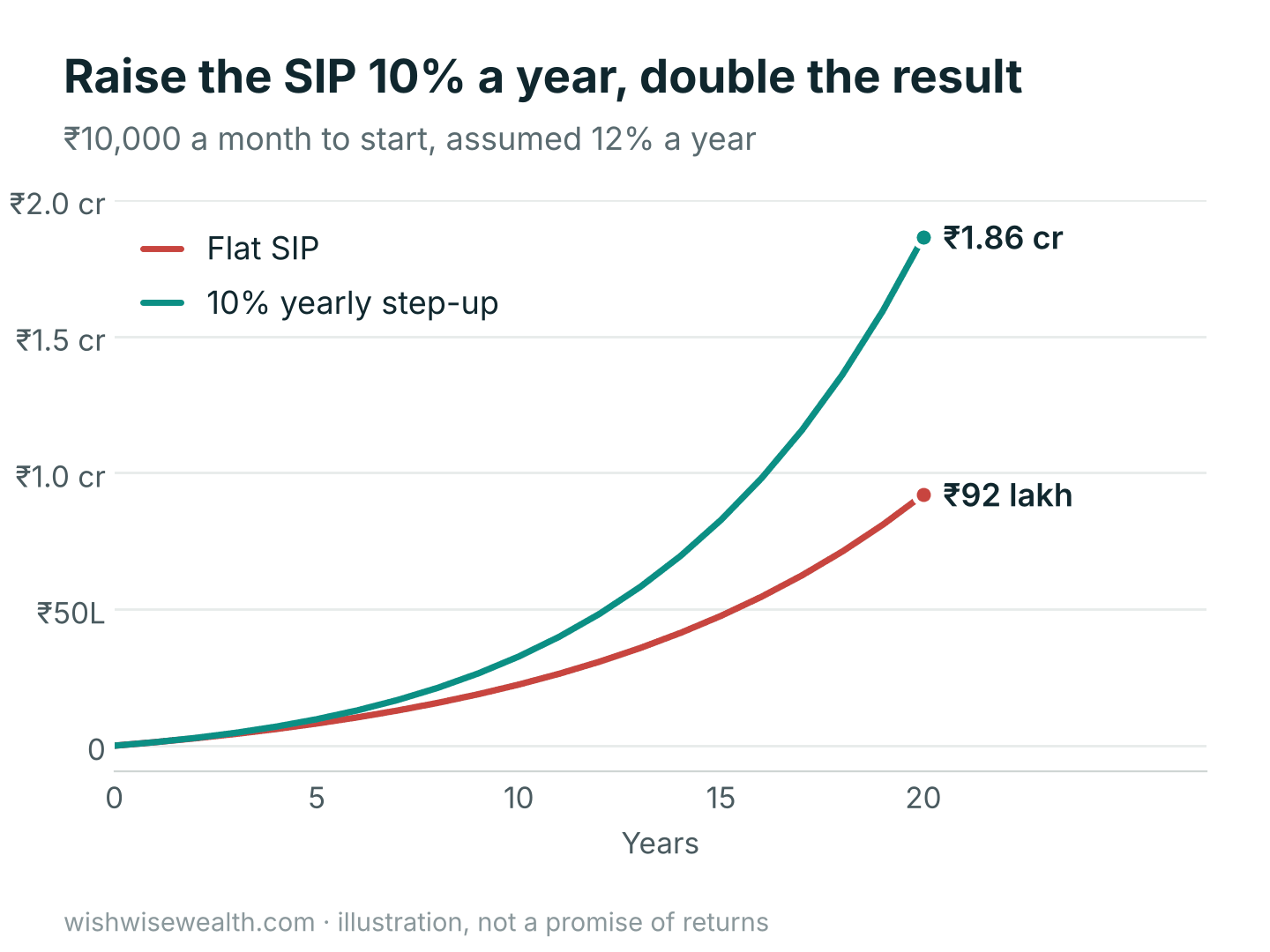
Take two colleagues who both start a SIP of ₹10,000 a month, earning an assumed 12% a year for 20 years.
- Riya keeps the SIP flat. She invests ₹24 lakh in total and ends with about ₹92 lakh.
- Arjun raises his SIP by 10% every year. In year two he invests ₹11,000 a month, in year three ₹12,100, and so on. He invests about ₹68.7 lakh in total and ends with about ₹1.86 crore — a little more than double Riya’s result.
Arjun’s final SIP in year 20 is about ₹61,000 a month. That sounds large today, but if his salary has grown by 10% a year too, it is the same share of his income as ₹10,000 was in year one. He never felt a bigger pinch than Riya did; he simply kept the habit in proportion to his life.
The step-up table
Here is a ₹10,000 starting SIP at an assumed 12% a year, with different yearly step-ups. The figure in brackets is how many times the flat SIP’s result it reaches.
| Years | Flat SIP | 5% step-up | 10% step-up | 15% step-up |
|---|---|---|---|---|
| 10 | ₹22.4 lakh | ₹26.9 lakh (1.2×) | ₹32.7 lakh (1.5×) | ₹40.0 lakh (1.8×) |
| 15 | ₹47.6 lakh | ₹61.9 lakh (1.3×) | ₹82.7 lakh (1.7×) | ₹1.13 crore (2.4×) |
| 20 | ₹92.0 lakh | ₹1.28 crore (1.4×) | ₹1.86 crore (2.0×) | ₹2.86 crore (3.1×) |
| 25 | ₹1.70 crore | ₹2.48 crore (1.5×) | ₹3.94 crore (2.3×) | ₹6.77 crore (4.0×) |
Two things stand out. First, the longer the horizon, the more the step-up matters — at 10 years a 10% step-up adds half again, at 25 years it more than doubles the result. Second, a big part of the extra corpus comes from your own extra contributions, not only from returns. That is not a weakness; it is the point. A step-up is a disciplined way to invest more as you earn more.
Why it works: compounding needs fuel
Compounding is often described as magic, but it is really just growth on growth. It needs two things: time and money. A flat SIP gives compounding time but starves it of fuel as the years pass, because ₹10,000 in year fifteen is worth far less than ₹10,000 in year one. A step-up keeps the fuel in line with inflation and with your income, so the later years — which compound the least — still carry real weight.
How much should you step up?
- Match your salary hike. If your pay rises 8% to 10% most years, a 10% step-up is natural.
- At least match inflation. A 5% to 6% step-up simply keeps your SIP’s real value steady. Less than that, and your SIP shrinks in real terms every year.
- Use a fixed amount if percentages feel abstract. Adding ₹1,000 or ₹2,000 every April works too, especially for smaller SIPs.
- Self-employed? Step up after a good year rather than on a fixed date, and keep the habit even in a modest year — even ₹500 more keeps the rule alive.
How to set it up
Many fund houses offer a “top-up” or “step-up” option on the SIP form, where you choose the yearly increase in rupees or as a percentage. Where that option is not available, you can start a second small SIP every year in the same scheme. Either way, link it to a date you will not forget — your increment month or your birthday works well. We set this up for our clients when they first start a SIP, so it happens without anyone having to remember.
Common worries
What if my income falls one year?
Pause the step-up, not the SIP. Most fund houses let you change or skip the top-up. Keeping the base SIP running is what matters most.
Is a step-up better than a bigger SIP from day one?
If you can afford a bigger SIP now, that is even better, because early money compounds for longest. A step-up is the practical way for most salaried people, whose ability to save grows over time.
Does the step-up change the risk?
No. The risk depends on which fund you invest in and for how long, not on the SIP amount. But because more money goes in during later years, keep an eye on your asset mix as the goal gets close.
Try your own numbers
Our step-up SIP calculator lets you change the starting amount, the step-up and the assumed return, and shows the flat and stepped results side by side on one chart. If you would like us to set up a step-up SIP for you, message us on WhatsApp.
Figures above are illustrations based on assumed rates of return and are not a promise or guarantee of future returns. Mutual fund investments are subject to market risks, read all scheme related documents carefully. WishWiseWealth is an AMFI-registered Mutual Fund Distributor (ARN-188221).