

A SIP builds money month by month. A Systematic Withdrawal Plan (SWP) does the reverse: it pays you a fixed amount every month from a mutual fund, while the rest of the money stays invested and keeps working. Retirees use it as a pension, parents use it to pay fees, and some people use it to supplement a rental or business income.
How an SWP works
Suppose you invest ₹50 lakh and ask for ₹30,000 on the 5th of every month. On each date the fund house sells just enough units to pay you ₹30,000 and credits it to your bank account. The remaining units stay invested. If the fund earns more than you withdraw, the balance grows; if it earns less, the balance slowly shrinks.
You can choose the amount, the date and the frequency — monthly, quarterly or yearly — and you can change or stop the SWP whenever you like. There is no lock-in, though some funds charge an exit load on units sold within the first year.
The number that decides everything: your withdrawal rate
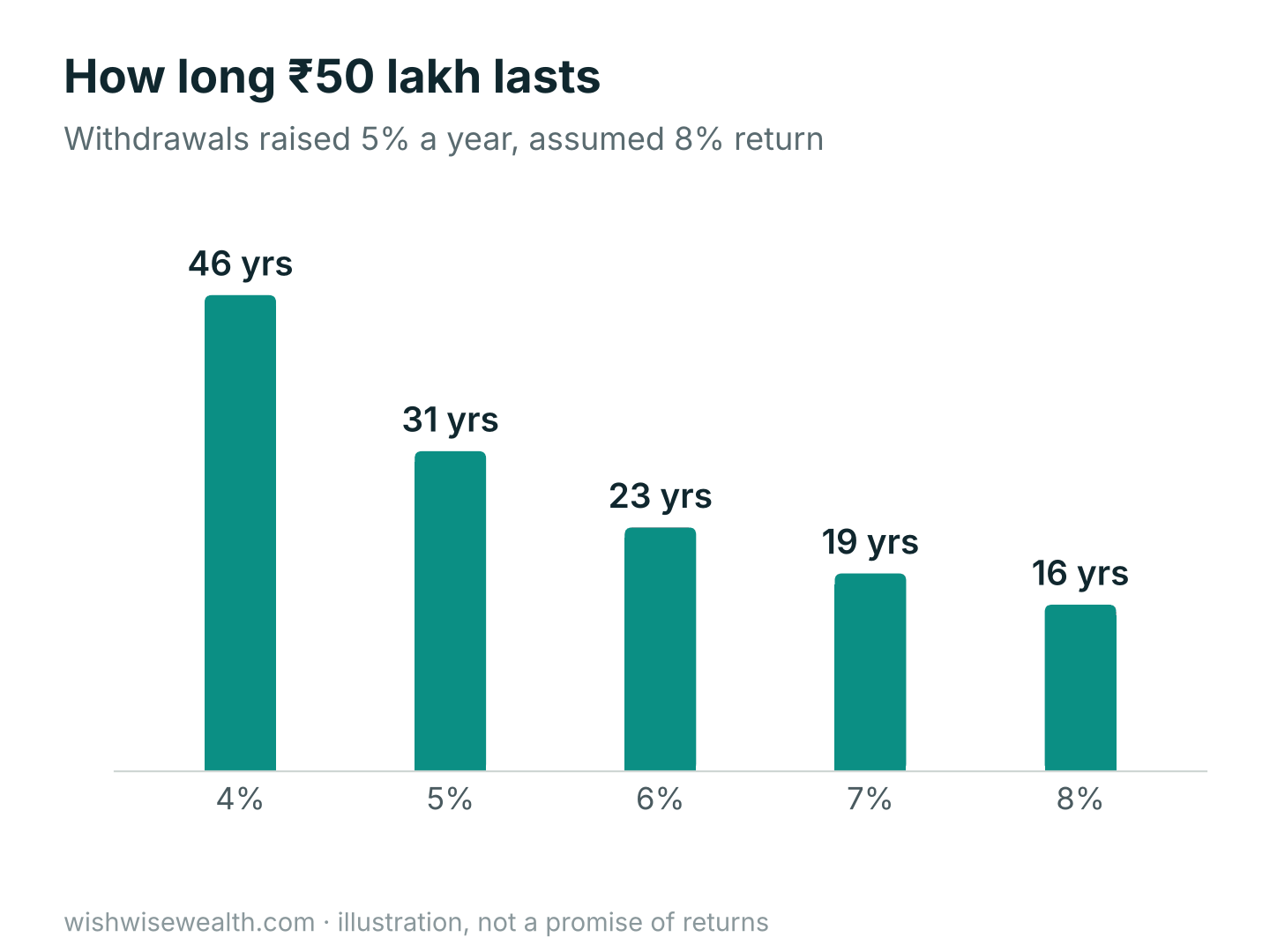
Your withdrawal rate is your yearly withdrawal as a share of the starting corpus. ₹30,000 a month from ₹50 lakh is ₹3.6 lakh a year, or 7.2%. This one number matters more than the fund you choose. Here is how long ₹50 lakh lasts at different withdrawal rates, assuming the money earns 8% a year and the monthly withdrawal is raised by 5% every year to keep up with rising prices:
| Withdrawal rate | Monthly income to start | Lasts about |
|---|---|---|
| 4% | ₹16,667 | 46 years |
| 5% | ₹20,833 | 31 years |
| 6% | ₹25,000 | 23 years |
| 7% | ₹29,167 | 19 years |
| 8% | ₹33,333 | 16 years |
If you never raise the withdrawal, the money lasts much longer — at 8% returns, any withdrawal rate up to 7% keeps the corpus growing. But a flat ₹30,000 will buy about half as much in twelve years at 6% inflation. For a retirement that may last 25 to 30 years, a withdrawal rate of 4% to 5% with yearly increases is the cautious starting point. If returns turn out to be 10% instead of 8%, a 6% withdrawal rate with 5% yearly increases lasts about 34 years.
Why an SWP is tax-efficient
With a fixed deposit, all the interest is added to your income and taxed at your slab rate every year, whether you spend it or not. With an SWP, each withdrawal is partly your own money coming back and partly gain. Only the gain part is taxed.
In the first year of the example above, if the fund rises steadily by 8%, only about ₹14,600 of the ₹3.6 lakh you withdraw is gain; the rest is your own capital. The gain share rises over the years, but for a long time the taxable amount stays small. How that gain is taxed depends on the type of fund and how long the units were held — see our plain-language tax guide. For equity-oriented funds held over a year, gains up to ₹1.25 lakh a year are tax-free.
Which fund for an SWP?
An SWP from a pure equity fund can be bumpy: in a year like 2020, when the Nifty 50 fell by more than a third in about two months, you would be selling units at low prices to pay your bills. Many retirees therefore draw from a conservative or balanced mix — hybrid funds, or a debt fund that is refilled from an equity fund once a year. Our article on the three-bucket SWP method shows one simple structure. The right mix depends on your age, other income and comfort with ups and downs.
Five rules for a safe SWP
- Start low. You can always raise the withdrawal later; cutting it in a bad year is painful.
- Keep one to two years of expenses outside the market, so a crash never forces you to sell equity at the bottom.
- Review once a year. If markets did well, take your yearly increase. If they fell sharply, skip the increase that year.
- Do not start an SWP in the first year of an equity fund if it has an exit load — begin from a fund you have held for a while, or from a debt or hybrid fund.
- Keep nominees updated on every folio. An SWP is often the main income for a surviving spouse.
Frequently asked questions
Is SWP better than the IDCW (dividend) option?
For regular income, usually yes. IDCW payouts are decided by the fund house, can vary or stop, and are fully taxed at your slab rate. An SWP pays the amount you choose and taxes only the gain portion.
Can I run an SWP and a SIP at the same time?
Yes, in different funds. A common example is a parent drawing an SWP from a debt fund for school fees while a SIP continues in an equity fund for a later goal.
What happens if the corpus runs low?
The SWP stops when the units run out. Reviewing every year avoids surprises; reducing the withdrawal by even 10% in a weak year can add several years to the plan.
Try different amounts and returns in our SWP calculator, or ask us on WhatsApp to plan a monthly income that suits you.
Figures above are illustrations based on assumed rates of return and are not a promise or guarantee of future returns. Mutual fund investments are subject to market risks, read all scheme related documents carefully. WishWiseWealth is an AMFI-registered Mutual Fund Distributor (ARN-188221).