

Retirement turns the investing problem upside down. For thirty years you added money every month and a market fall was an opportunity. Now you take money out every month, and a fall in the wrong year can hurt. The three-bucket method is a simple way to keep paying yourself without being forced to sell shares at the bottom of a crash.
The idea in one picture
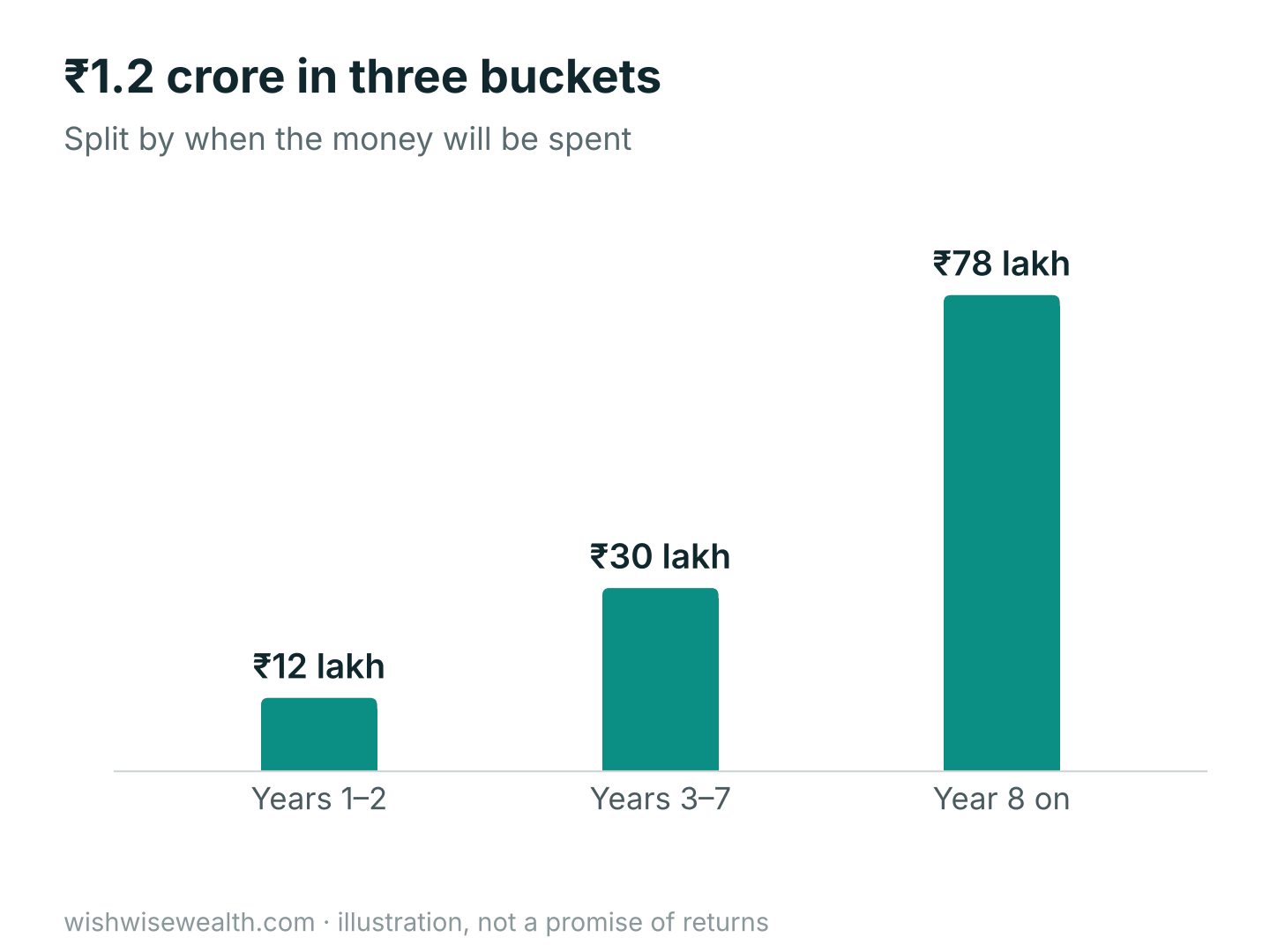
Divide your corpus by when you will spend it:
- Bucket 1 — the next 2 years of expenses. Kept in a liquid or ultra-short-duration debt fund, plus some in the bank. This bucket pays your monthly SWP.
- Bucket 2 — years 3 to 7. Kept in steadier funds such as short-duration debt or conservative hybrid funds. It refills Bucket 1.
- Bucket 3 — year 8 onwards. Kept in growth assets — equity or aggressive hybrid funds — because this money has time to ride out falls. It refills Bucket 2.
A worked example
Ramesh and Sunita retire at 60 with ₹1.2 crore. Their essential expenses are ₹50,000 a month (₹6 lakh a year), which they expect to rise about 6% a year. Their withdrawal rate is 5% of the corpus — on the sensible side.
| Bucket | Covers | Amount | Where |
|---|---|---|---|
| 1 | Years 1–2 | ₹12 lakh | Liquid / ultra-short debt fund; SWP of ₹50,000 a month |
| 2 | Years 3–7 | ₹30 lakh | Short-duration debt and conservative hybrid funds |
| 3 | Year 8 onwards | ₹78 lakh | Diversified equity and aggressive hybrid funds |
If the three buckets together earn around 9% to 10% a year over the long run, and the couple raise their withdrawal by 6% every year, the money lasts roughly 31 to 39 years — well into their nineties. If they raise it by only 5% a year, it lasts longer still. These are assumptions, not promises, which is exactly why the bucket structure matters: it gives the growth bucket time to recover from bad years.
The refilling rules
The method works only with simple rules, decided in advance and checked once a year:
- Good year for equity (Bucket 3 up by, say, 10% or more): move one year’s expenses from Bucket 3 to Bucket 2, and one year from Bucket 2 to Bucket 1.
- Ordinary year: move one year’s expenses from Bucket 2 to Bucket 1. Leave Bucket 3 alone.
- Bad year for equity (Bucket 3 down): do not sell equity. Refill Bucket 1 from Bucket 2 only. Bucket 2 holds five years of expenses precisely so that a long fall does not force a sale.
- Every year, raise the SWP by the inflation rate you planned — or skip the raise after a very bad year.
Why it helps
The biggest danger in retirement is called sequence risk: a big market fall early in retirement, while you are also withdrawing, can shrink the corpus so much that it never recovers — even if average returns over thirty years turn out fine. Buckets 1 and 2 hold seven years of spending outside equity, so you can wait out a fall like 2008, when Indian shares took about three years to regain their peak. The method also helps emotionally: when markets crash, you can see that the next two years of income are already sitting safely in Bucket 1.
Tax and practical details
- SWP is tax-efficient: only the gain portion of each withdrawal is taxed. See our tax guide for how each fund type is taxed.
- Senior citizen schemes can sit in Bucket 2. Government-backed options such as the Senior Citizens’ Savings Scheme pay a fixed quarterly interest and can replace part of the debt bucket.
- Keep the health cover going. A hospital bill paid from Bucket 3 in a bad year breaks the whole structure.
- Simplify the folios. Two or three funds per bucket is plenty, and makes life easier for your spouse.
Frequently asked questions
Is ₹1.2 crore enough to retire?
It depends entirely on expenses. At ₹50,000 a month it is a reasonable 5% withdrawal rate. At ₹80,000 a month it would be 8%, which is likely to run out in the late seventies. Our article on how much you need to retire walks through the calculation.
What if we have a pension too?
Subtract the pension from your expenses first. Only the gap needs to come from the buckets, which makes the plan much safer.
Can we do this ourselves?
Yes, if you are comfortable with the yearly refilling. Many retirees prefer to have someone run the yearly review with them. Message us on WhatsApp and we will draw up the buckets with your own numbers. You can also test withdrawals in our SWP calculator.
Figures above are illustrations based on assumed rates of return and are not a promise or guarantee of future returns. Mutual fund investments are subject to market risks, read all scheme related documents carefully. WishWiseWealth is an AMFI-registered Mutual Fund Distributor (ARN-188221).