

We meet many families with well-chosen SIPs and no real protection behind them — a small life policy bought for tax, and the employer’s group health cover that ends the day the job does. Their plan is built on a single assumption: that nothing bad will happen. Insurance replaces that assumption with a safety net. That is why it comes first.
The right order
- Health insurance for the whole family.
- Term life insurance for every earning member with dependants.
- An emergency fund of three to six months of expenses.
- Then SIPs for your goals.
Each layer protects the next. Without health cover, a hospital bill empties the emergency fund. Without an emergency fund, a job loss breaks the SIPs. Without term cover, the family’s goals die with the earner.
Term insurance: how much is enough?
Term insurance pays a lump sum to your family if you die during the policy term. There is no maturity value, which is exactly why it is cheap. A ₹1 crore cover for a healthy, non-smoking 30-year-old often costs roughly ₹10,000 to ₹15,000 a year, depending on age, health, insurer and term.
Two common ways to size the cover:
- Rule of thumb: 10 to 15 times your annual income, plus outstanding loans.
- Needs-based: add up what your family would need — all loans, each child’s education and marriage goals, and enough to replace your income for household expenses until your spouse can manage or your children are independent — then subtract existing savings.
For someone earning ₹12 lakh a year with a ₹30 lakh home loan, both methods usually land between ₹1.5 crore and ₹2 crore. Choose a term that runs until your working life ends, typically age 60 or 65.
Health insurance: base plus super top-up
Medical costs in private hospitals rise faster than general prices, and a single major surgery or ICU stay can cost several lakh rupees. A practical structure for a family:
- A family floater base policy of ₹10 lakh or more.
- A super top-up of ₹25 lakh to ₹50 lakh that pays after a deductible — say, after the first ₹10 lakh of bills in a year. Super top-ups are inexpensive because they only start after the deductible.
- Your own policy even if your employer covers you. Group cover ends when you change or lose your job, and buying fresh cover at 50 with a health condition is hard and costly.
- Parents on a separate policy, so their claims do not use up your family’s cover.
Why mixing insurance and investment usually costs more
Endowment and money-back policies combine a small life cover with a savings plan. Many have worked out to returns of roughly 4% to 6% a year over their term. Compare two choices for a 30-year-old over 20 years:
| Endowment policy | Term cover + SIP of the difference | |
|---|---|---|
| Yearly outlay | ₹50,000 | ₹13,000 term premium + ₹37,000 invested (about ₹3,083 a month) |
| Life cover | About ₹10 lakh | ₹1 crore |
| Value after 20 years | About ₹17.4 lakh (at 5% a year) | About ₹17.7 lakh at 8%, or ₹22.3 lakh at 10% (assumed) |
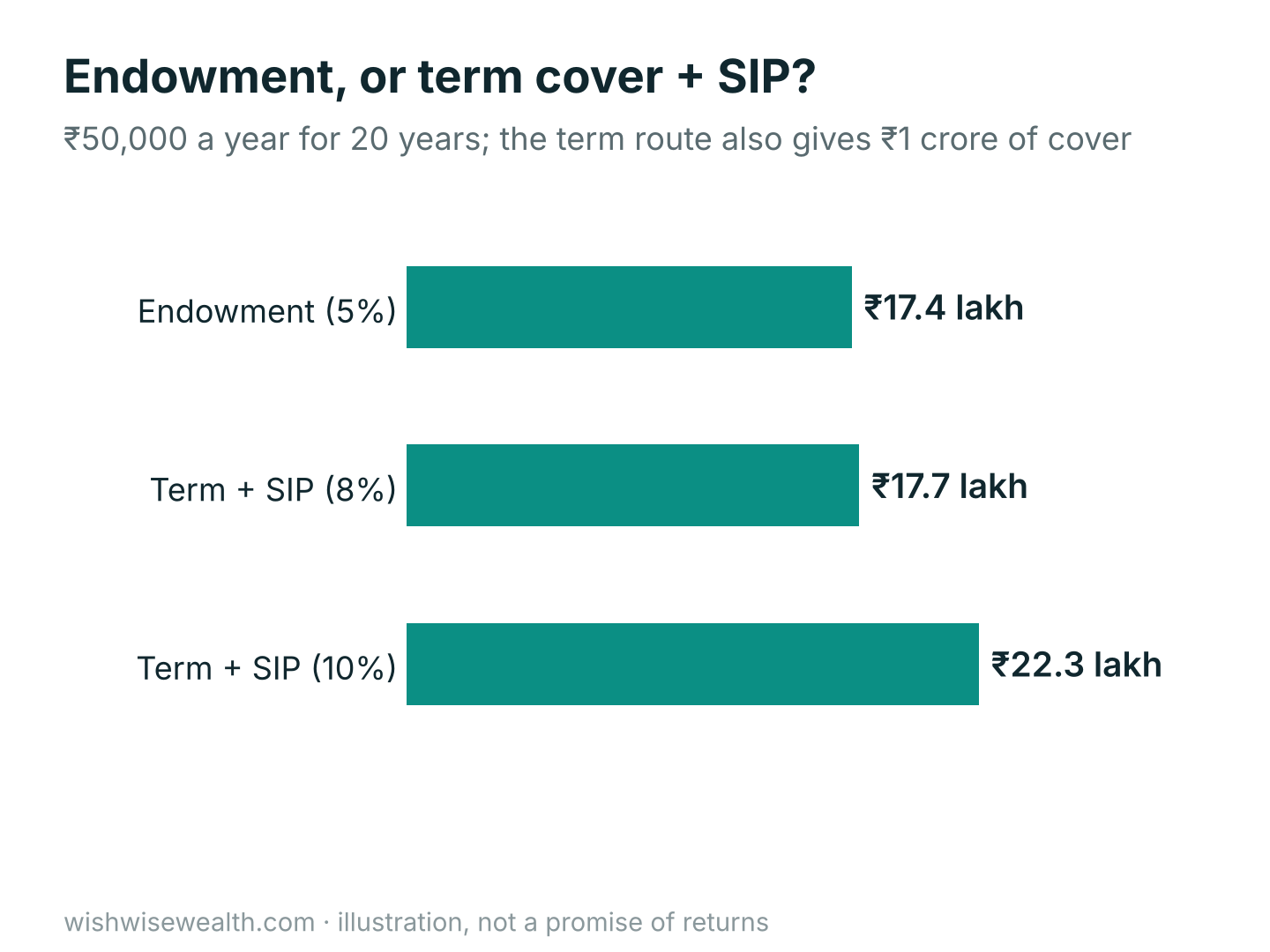
Even if the investment earns only modestly more than the policy, the family is protected for ten times the amount. That protection is the real difference. If you already hold an endowment policy, do not surrender it in a hurry — surrender values in early years can be low. Ask for a review of whether to continue, make it paid-up, or surrender.
Common mistakes
- Buying cover only for tax. The deduction for premiums is available only under the old tax regime, and the tax saved is small next to the cost of being under-insured.
- Hiding health history. Disclose everything when you apply. Non-disclosure is the most common reason claims are rejected.
- Insuring children’s lives instead of the parents’. The person whose income the family depends on needs the cover.
- Forgetting to tell the family. Record policy numbers and nominees in your family binder.
Frequently asked questions
I am 45. Is term insurance still worth it?
Yes, if anyone depends on your income or you have loans. Premiums are higher, so a shorter term up to 60 and a needs-based cover keep it affordable.
Should a homemaker have life cover?
A homemaker’s work has real economic value — childcare, cooking, caring for elders. A modest term cover helps the family pay for that support if needed.
We are a mutual fund distributor and do not sell insurance on this website, but insurance is the first thing we check in every family’s plan. Message us on WhatsApp for a free review of your protection and investments together.
Figures above are illustrations based on assumed rates of return and are not a promise or guarantee of future returns. Mutual fund investments are subject to market risks, read all scheme related documents carefully. WishWiseWealth is an AMFI-registered Mutual Fund Distributor (ARN-188221).