

Ask parents what their child’s higher education will cost and most will quote today’s fee. The trouble is that the fee will not be paid today. Education costs in India have risen much faster than general prices — 8% to 12% a year is a common planning range for private professional courses. That single fact changes the size of the goal more than anything else.
Step 1: turn today’s cost into the future cost
Suppose a four-year professional degree, with tuition, hostel and living costs, comes to about ₹10 lakh today. If costs rise 10% a year:
| Child’s age today | Years to college (age 18) | Likely cost then |
|---|---|---|
| 3 | 15 | about ₹41.8 lakh |
| 8 | 10 | about ₹25.9 lakh |
| 13 | 5 | about ₹16.1 lakh |
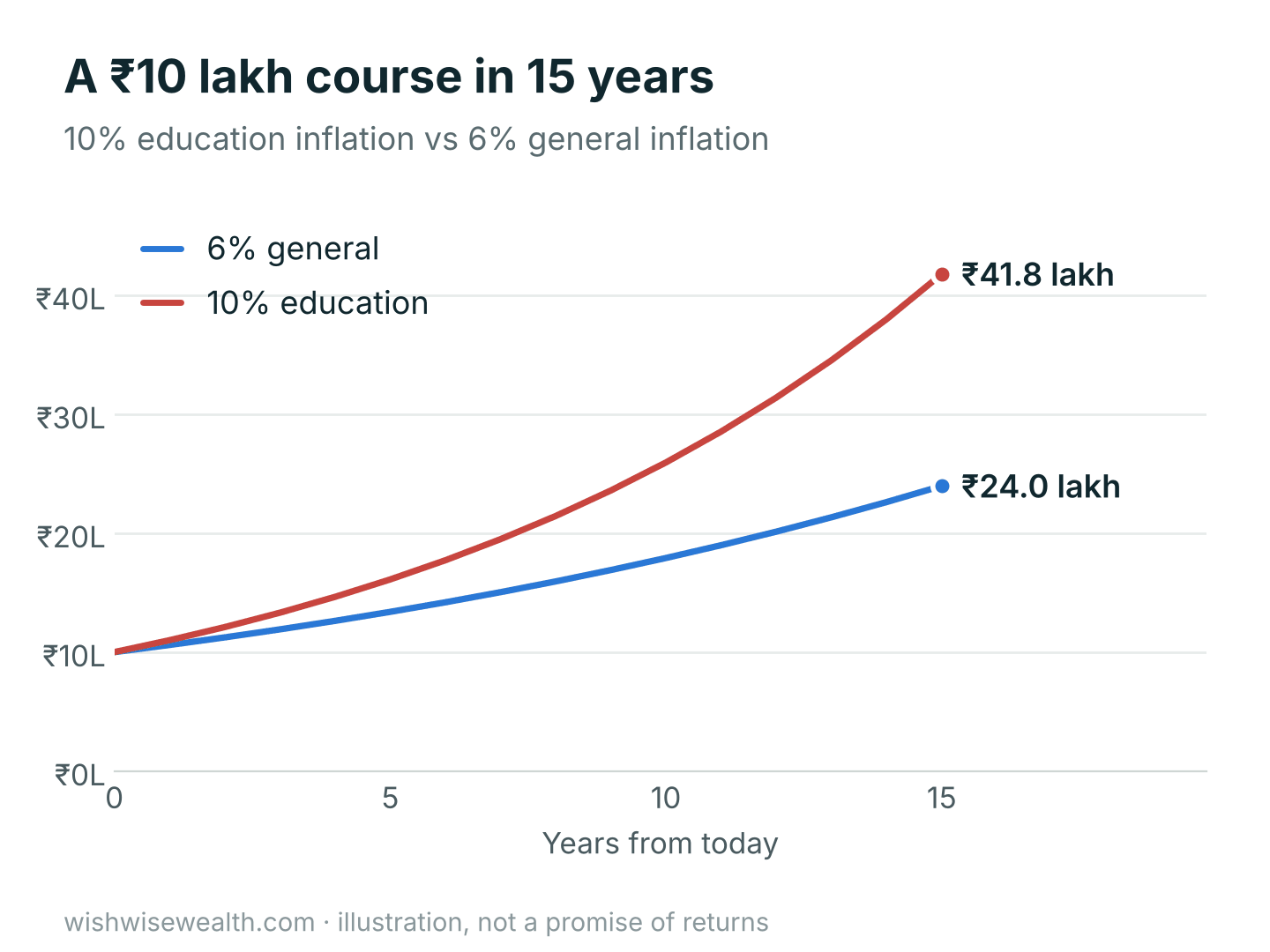
At general inflation of 6%, the same course would cost about ₹24 lakh in 15 years. The extra 4% a year of education inflation adds almost ₹18 lakh to the goal. That is why we plan education with its own inflation rate, not the headline one.
Step 2: how much to invest each month
For long horizons, an equity-oriented fund is the usual engine; for short horizons, a more conservative mix. Here is the monthly SIP needed to reach the future cost above:
| Years to go | Assumed return | Flat monthly SIP | SIP with 10% yearly step-up (starting amount) |
|---|---|---|---|
| 15 | 12% | ₹8,777 | ₹5,048 |
| 10 | 12% | ₹11,577 | ₹7,935 |
| 5 | 8% (conservative mix) | ₹21,937 | ₹18,231 |
Two lessons jump out. Starting when the child is three needs well under half the monthly effort of starting at thirteen. And a step-up SIP that rises with your salary makes an early start very affordable — about ₹5,000 a month to begin with. If you have a lump sum instead, about ₹7.6 lakh invested today at an assumed 12% would grow to the same ₹41.8 lakh in 15 years.
Step 3: protect the money as the date approaches
The biggest risk to an education fund is not a low return over fifteen years. It is a market fall in the year before admission. A 30% fall when your child is seventeen leaves no time to recover. So the plan needs a glide path:
- More than 5 years away: mostly equity, in diversified funds.
- 3 to 5 years away: start moving a portion each year into hybrid or short-term debt funds.
- Last 2 to 3 years: the amount needed for the first year’s fees should be in low-risk debt funds or deposits; later years’ fees can stay a little longer in a balanced mix.
A Systematic Transfer Plan (STP) from the equity fund to a debt fund makes this shift gradual and automatic.
Things families often forget
- Two children, two goals. Plan each child separately, with separate folios named for them.
- Coaching and entrance costs in the last two school years can be significant. Budget for them as a smaller, nearer goal.
- Studying abroad is a different goal altogether: costs are in dollars or pounds, so the rupee’s fall adds to inflation. If it is a real possibility, plan for a higher number.
- Protect the goal if something happens to you. A term insurance cover large enough to fund the child’s education is part of the plan, not an extra.
- Loans and scholarships help, but do not plan around them. An education loan is useful for the gap; it should not be the whole plan.
Frequently asked questions
Should I use a “children’s fund”?
Some schemes are labelled for children and carry a lock-in of five years or until the child turns 18, whichever is earlier. They can work, but a regular diversified fund with a clear goal name gives you more flexibility. The label matters less than the discipline.
What about Sukanya Samriddhi for a daughter?
It is a safe, government-backed scheme with tax benefits under the old regime, and it suits part of a daughter’s education or marriage goal. Because it is fixed-income, it works best alongside an equity SIP for long horizons rather than instead of one.
Should the investment be in the child’s name?
Investments can be made in a minor’s name with a parent as guardian. Income from them is usually added to the parent’s income for tax until the child turns 18. Either way, name the folio or goal clearly so it is not used for anything else.
Work out your own numbers with our goal calculators, or message us on WhatsApp and we will build a plan for each child.
Figures above are illustrations based on assumed rates of return and are not a promise or guarantee of future returns. Mutual fund investments are subject to market risks, read all scheme related documents carefully. WishWiseWealth is an AMFI-registered Mutual Fund Distributor (ARN-188221).