

Every mutual fund scheme in India comes in two versions that hold exactly the same shares and bonds and are run by the same fund manager. The only difference is how you buy it and what it costs. Because we are a mutual fund distributor and are paid through regular plans, we think you deserve a straight explanation from us rather than a sales pitch.
The difference in one line
- Direct plan: you buy straight from the fund house or a direct-plan platform. No distributor is involved, so the yearly expense ratio is lower.
- Regular plan: you buy through a mutual fund distributor. The fund house pays the distributor a commission from the scheme’s expenses, so the expense ratio is higher.
The expense ratio is deducted from the fund every day, so you never see a bill. It shows up only as a slightly different NAV. That is why the two plans of the same scheme have different NAVs and slightly different returns.
What the difference costs over time
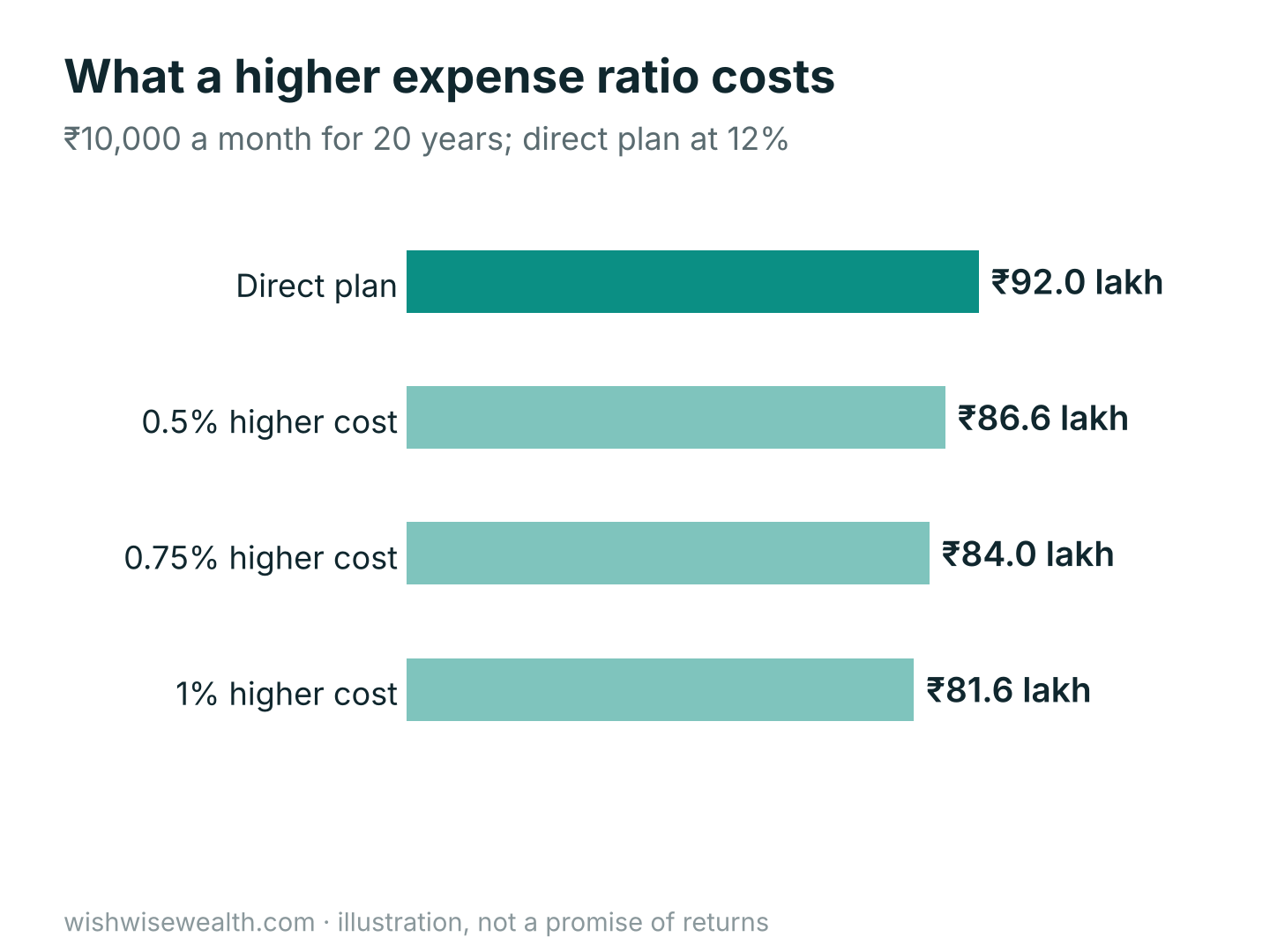
For equity funds, the gap between the regular and direct expense ratio is commonly in the range of about 0.5% to 1% a year, depending on the scheme. Here is what that means for a ₹10,000 monthly SIP over 20 years, if the direct plan earns an assumed 12% a year:
| Yearly cost difference | Direct plan corpus | Regular plan corpus | Difference |
|---|---|---|---|
| 0.50% | ₹92.0 lakh | ₹86.6 lakh | ₹5.4 lakh (5.8%) |
| 0.75% | ₹92.0 lakh | ₹84.0 lakh | ₹7.9 lakh (8.6%) |
| 1.00% | ₹92.0 lakh | ₹81.6 lakh | ₹10.4 lakh (11.3%) |
That is real money and we will not pretend otherwise. You can check the exact expense ratio of both plans of any scheme in its factsheet or on the AMFI website.
What the regular plan pays for
A distributor’s job is not to find a “secret” fund. It is to help you avoid the mistakes that cost far more than 1% a year:
- Staying invested in a crash. Stopping a SIP in a fall, or selling at the bottom, can wipe out years of returns. In March 2020 many investors who were on their own redeemed in panic; those who stayed recovered within months.
- Matching funds to goals. Money for a school fee due in two years should not sit in a small cap fund. Getting that wrong is expensive.
- Paperwork that protects your family: KYC updates, nominees on every folio, bank mandate changes and, one day, transmission of units to your family without months of running around.
- A yearly review: rebalancing, stepping up SIPs and consolidating scattered folios.
Whether that is worth the cost is your decision. For some people it clearly is; for others it is not.
Who should consider which
| Direct plans suit you if… | Regular plans suit you if… |
|---|---|
| You enjoy reading factsheets and can choose funds for each goal yourself. | You would rather have a person check your plan and choices. |
| You have stayed invested through a big market fall before. | You are investing for the first time or worry about market falls. |
| You will handle KYC, nominations and paperwork on your own. | You want help with paperwork, changes and family transmission. |
| You review and rebalance at least once a year. | You want a scheduled yearly review. |
How to judge any distributor — including us
- Check the ARN. Every distributor must be registered with AMFI. Ours is shown on every page; you can verify it on amfiindia.com.
- Ask how they are paid. A distributor earns commission from fund houses. They must disclose it, and your Consolidated Account Statement (CAS) shows the commission paid to your distributor in rupees.
- Watch for churn. Frequent switching between schemes for no clear reason helps nobody except the person suggesting it.
- Distributor or adviser? A SEBI-registered investment adviser charges you a fee and recommends direct plans. A distributor like us is paid through regular plans. Both are legitimate; just know which one you are dealing with.
Frequently asked questions
Can I switch from regular to direct later?
Yes. A switch is treated as a redemption and fresh purchase, so capital-gains tax and any exit load apply. For large, long-held investments, work out the tax before switching.
Does the fund manager treat the two plans differently?
No. Both plans hold the same portfolio. Only the expenses differ.
Questions about what you pay? Ask us on WhatsApp — we will answer them openly. Our About page explains how we work.
Figures above are illustrations based on assumed rates of return and are not a promise or guarantee of future returns. Mutual fund investments are subject to market risks, read all scheme related documents carefully. WishWiseWealth is an AMFI-registered Mutual Fund Distributor (ARN-188221).