


Most families judge a home loan by one number: the EMI. Can we afford ₹40,000 a month? If yes, we sign. The number that really hurts is the one nobody prints in large type on the sanction letter — the total interest you will pay over the life of the loan. This article puts that number on the table and shows a simple way to win it back.
What a ₹50 lakh loan really costs
Take a ₹50 lakh loan at 8.5% a year for 25 years. The EMI works out to about ₹40,261. Over 300 months you repay roughly ₹1.21 crore. Subtract the ₹50 lakh you borrowed and about ₹70.8 lakh is pure interest — more than the loan itself.
The interest is also front-loaded. In the first year alone you pay about ₹4.2 lakh of interest and only about ₹60,000 of principal. That is why a loan feels as if it is not reducing for the first several years.
The idea: a small SIP that runs beside the EMI
Start a monthly SIP in an equity mutual fund on the same day your first EMI goes out, and keep it running for the same 25 years. The SIP does not reduce what you owe the bank — you still pay every rupee of interest. But by the time the loan closes, the SIP has built a corpus equal to that interest. On paper, the house has cost you only the principal.
How big does the SIP need to be? It depends on the return you assume. We show three, because nobody can promise one:
| Assumed return a year | Monthly SIP needed | As a share of the EMI |
|---|---|---|
| 10% | ₹5,694 | 14% |
| 11% | ₹4,870 | 12% |
| 12% | ₹4,158 | 10% |
The rule of thumb is easy to remember: set aside 10% to 15% of your EMI as a SIP. The lower the return you assume, the closer to 15% you should go. We always show the lower figure too, because planning with the comfortable number is how plans fail.
A smaller loan, the same logic
A ₹30 lakh loan at 8.5% for 20 years has an EMI of about ₹26,035 and total interest of about ₹32.5 lakh. To recover that interest you need a SIP of roughly ₹3,531 a month at an assumed 12%, or ₹4,487 at 10%. Because the tenure is shorter, the SIP is a larger share of the EMI — about 14% to 17%. Shorter loans cost less interest in total, but the compounding also has less time to work.
Should you prepay the loan instead?
This is the first question most people ask, and it deserves an honest answer. Suppose that instead of a ₹4,158 SIP you add the same ₹4,158 to your EMI every month. The loan closes in about 18 years and 11 months instead of 25 years, and you save about ₹20.3 lakh of interest. That saving is guaranteed — it does not depend on the stock market.
To compare fairly, assume that once the loan is closed you invest the full EMI plus the extra ₹4,158 every month until year 25. Both paths then cost you exactly the same amount each month for 25 years. Here is what each family holds at the end:
| Return the investments earn | Path A: SIP beside the loan | Path B: prepay, then invest |
|---|---|---|
| 8% a year | about ₹38.0 lakh | about ₹41.5 lakh |
| 10% a year | about ₹51.7 lakh | about ₹44.1 lakh |
| 12% a year | about ₹70.8 lakh | about ₹46.9 lakh |
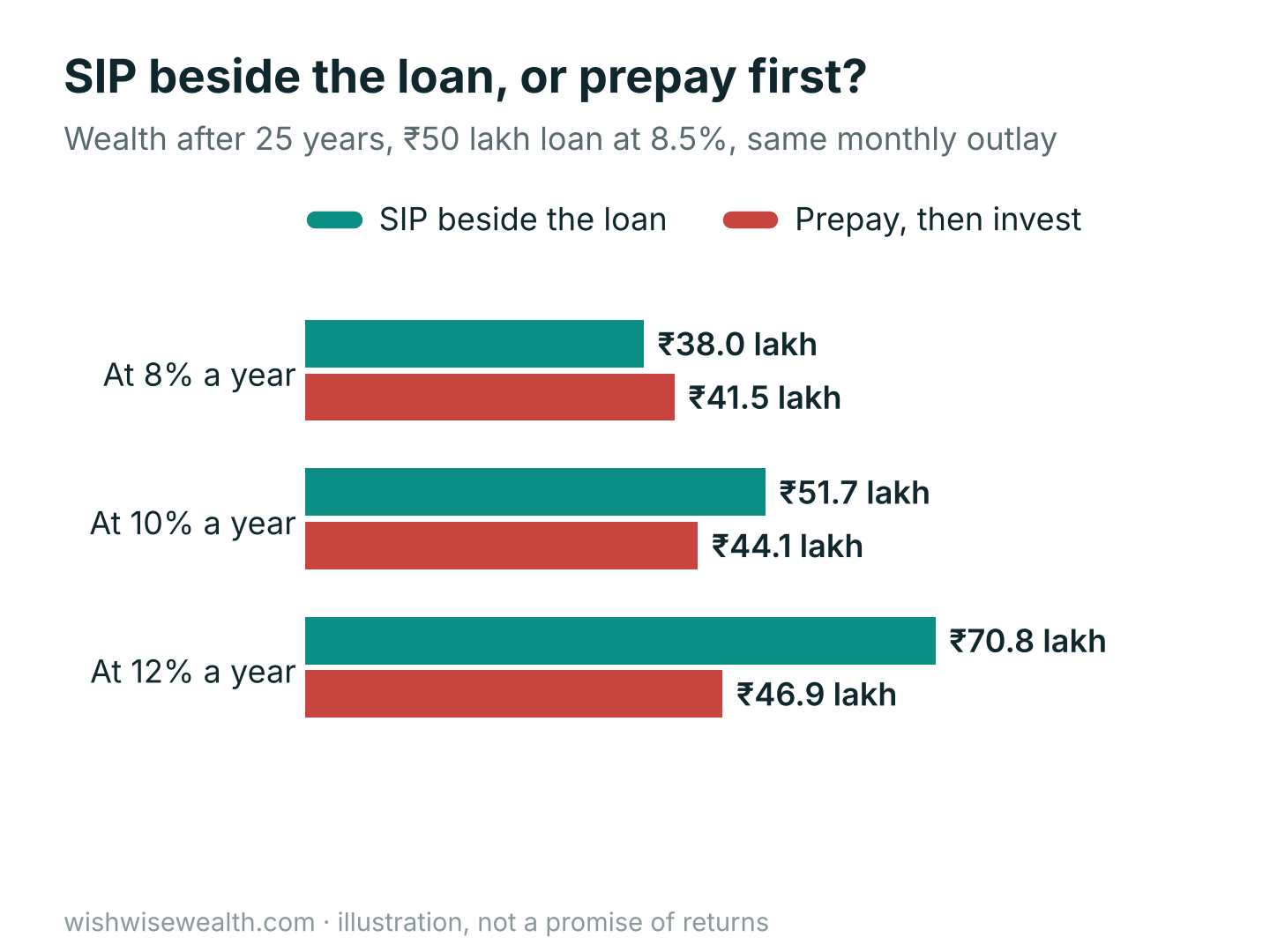
The pattern is clear. If your investments earn only about as much as the loan costs, prepaying wins and carries no market risk. If they earn clearly more than the loan rate over a long period, the SIP wins, sometimes by a wide margin. Many families split the difference: they run the SIP and also put part of every bonus into prepayment. There is no single right answer — it depends on how you feel about debt and about market swings.
Tax changes the picture a little
Under the old tax regime, interest of up to ₹2 lakh a year on a self-occupied home can be deducted from your income. That lowers the real cost of the loan for people in higher tax slabs and makes prepayment slightly less attractive in the early years. The new tax regime does not allow this deduction for a self-occupied home. Check which regime you file under before deciding.
What can go wrong
- Returns are not fixed. Some 25-year periods have delivered more than 12% a year in Indian equity; others less. That is why the table shows 10% as well.
- Stopping the SIP in a market fall. This is the most common way the plan fails. Treat the SIP as part of the EMI, not as an optional extra.
- Floating rates move. Most home loans are linked to an external benchmark. When rates rise, banks usually extend the tenure rather than raise the EMI, which quietly raises total interest. Ask your bank to keep the tenure fixed and raise the EMI instead, and review your SIP every year.
- Using the corpus early. If the SIP money is spent on a car or a holiday in year eight, the plan is gone. Give it a clear name, such as “home-loan recovery”.
A simple plan you can start this month
- Write down your loan amount, rate and remaining tenure from your latest loan statement.
- Open our home-loan interest recovery calculator and enter them. Note the SIP needed at 10% and at 12%.
- Start a SIP between those two numbers, dated a few days after your EMI.
- Every year, raise the SIP by the same percentage as your salary hike.
- Put part of every bonus into loan prepayment if being debt-free sooner matters to you.
Frequently asked questions
Which kind of fund suits this goal?
Because the horizon is 15 to 25 years, an equity-oriented fund such as a flexi cap or a large and mid cap fund is commonly used. The choice should match your comfort with risk; we help clients pick schemes suited to their situation.
I am 45 and have 15 years left on my loan. Is it too late?
No, but the SIP needs to be a larger share of the EMI, and you should keep the money in a more conservative mix as you approach the final years. The calculator shows the exact figure for your remaining tenure.
Can I use the corpus to close the loan early?
Yes. Once the SIP corpus equals the outstanding principal, you can redeem and close the loan, after considering capital-gains tax. Some families do exactly this in year 15 or 18.
Want us to work out your own numbers? Send us a message on WhatsApp with your loan details.
Figures above are illustrations based on assumed rates of return and are not a promise or guarantee of future returns. Mutual fund investments are subject to market risks, read all scheme related documents carefully. WishWiseWealth is an AMFI-registered Mutual Fund Distributor (ARN-188221).